
EL Client Architecture
Kiến trúc của Execution Layer client
Client Architecture
Overview
Beyond execution layer's fundamental role of transaction execution, the execution layer client undertakes several critical responsibilities. These include verification of the blockchain data and storing its local copy, facilitating network communication through gossip protocols with other execution layer clients, maintaining a transaction pool, and fulfilling the consensus layer's requirements that drive its functionality. This multifaceted operation ensures the robustness and integrity of the Ethereum network.
The client's architecture is built around a variety of specific standards, each of which plays a unique role in the overall functionality. The execution engine is located at the top, driving the execution layer, which in turn is driven by the consensus layer. The execution layer runs on top of DevP2P, the networking layer, which is initialized by providing legitimate boot nodes that provide an initial access point into the network. When we call one of the engine API methods, such as fork choice updated, we can download blocks from peers by subscribing to topics like our preferred mode of sync.
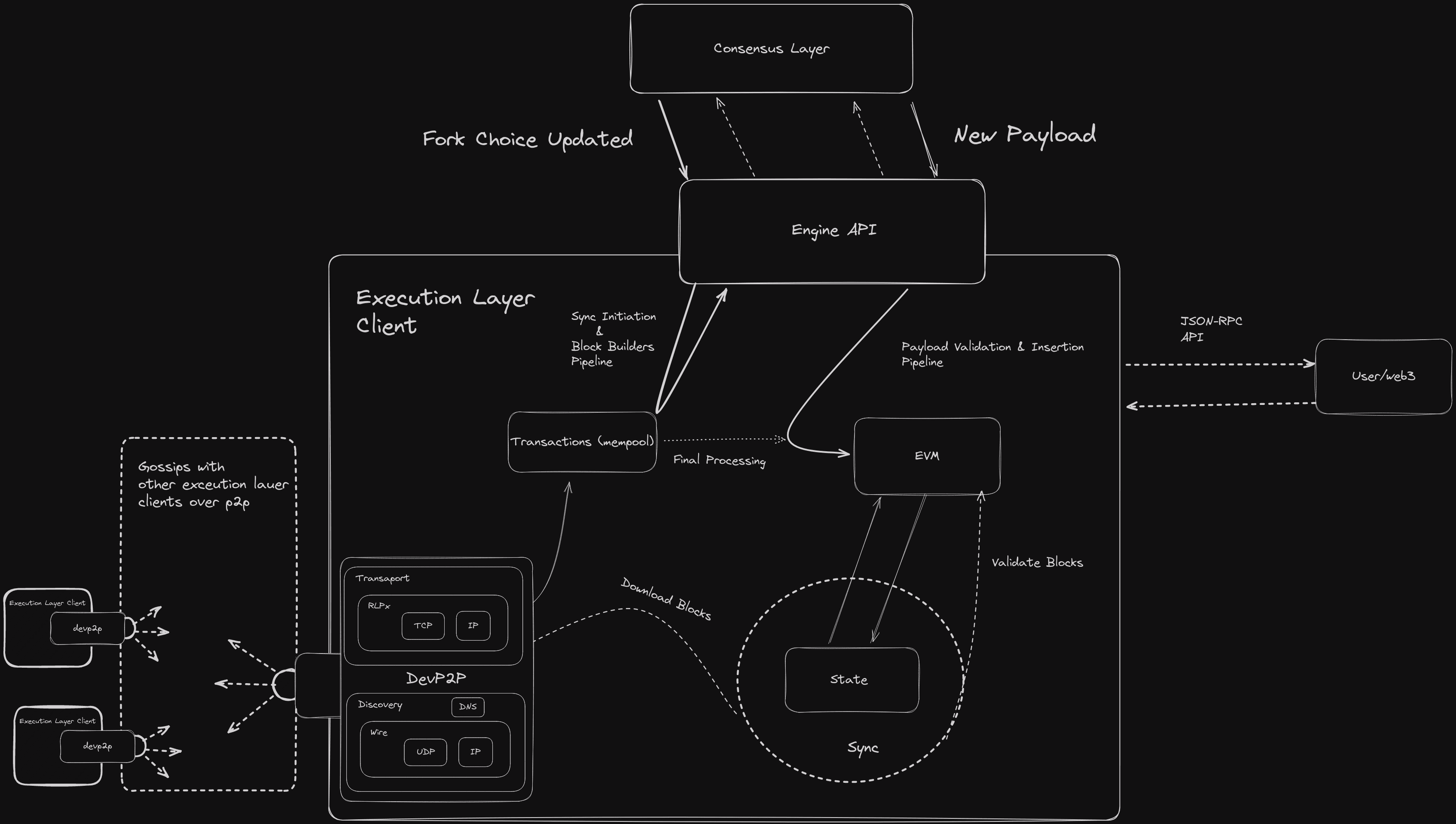
The diagram illustrates a simplified representation of the design, excluding several components.
EVM
Ethereum is centered around a virtualized central processing unit (CPU). Computers have their own central processing units (CPUs) at a hardware level, which can be of many types such as x86, ARM, RISC-V, or others. These varied processor architectures have unique instruction sets that enable them to perform tasks such as arithmetic, logic, and data manipulation, allowing the computer to function as a general-purpose computing machine. Therefore, when executing a program written in the hardware-level instruction set, the outcome may vary depending on the specific hardware on which it is executed. Thus In computer science, we address this problem by virtualizing instruction sets through the creation of virtual machines, such as the JVM (Java Virtual Machine). These virtual machines ensure consistent results regardless of the underlying hardware. The EVM is a virtualized execution engine designed for ethereum programs. It ensures consistent results regardless of the hardware it runs on and facilitates consensus among all Ethereum clients regarding computation outcomes.
In addition, Ethereum incorporates a sandwich complexity model as part of its design philosophy. This implies that the outer layers should be uncomplicated, while all the intricacy should be concentrated in the middle layers. In this context, the EVM's code can be seen as the outermost layer, while a high-level language like Solidity may be considered as the top layer. In between, there is a complicated compiler that translates the solidity code into the EVM's bytecode.
State
Ethereum is a general purpose computational system that operates as a state machine, meaning it may transition between several states depending on the inputs it receives. In addition, Ethereum differs significantly from other blockchains like Bitcoin in that it maintains a global state, whereas Bitcoin only keeps global unspent transaction outputs (UTXOs). The term "state" refers to the comprehensive collection of data, data structures (such as Merkle-Patricia Tries), and databases that store various information. This includes addresses, balances, code and data for contracts, as well as the current state and network state.
Transactions
The EVM produces data and modifies the state of the Ethereum network through a process called state transition. This state transition is triggered by transactions, which are processed within the EVM. If a transaction is deemed legitimate, it results in a state change of the Ethereum network.
DevP2P
The interface for communicating with other execution layer clients. Transactions are initially stored in the mempool, which serves as a repository for all incoming transactions, and are disseminated by execution layer clients to other execution layer clients in the network using peer-to-peer communication. Every recipient of the transaction sent over the network confirms its validity before broadcasting it to the network.
JSON-RPC API
When utilizing a wallet or a DApp, our communication with the execution layer is conducted over a standardized JSON-RPC API. This enables us to externally query the Ethereum state or dispatch a transaction to it, signed by the wallet, which is subsequently validated by the execution layer client and disseminated around the network.
Engine API
The Engine API lives in the Execution Layer and is used exclusively for internal communication between the Consensus Layer and the Execution Layer (EL). The engine exposes two major classes of endpoints to the consensus layer: fork choice updated and new payload suffixed by the three versions they are exposed as (V1-V3).
-
New Payload (V1/V2/V3):
Handles payload validation and insertion. When the CL receives a new beacon block, it extracts the execution payload and callsengine_newPayloadon the EL. The EL validates the payload by:- Checking that the parent block hash in the payload header exists and matches the expected parent in the local chain.
- Verifying any additional execution commitments (e.g. post-Cancun data).
- Executing transactions and updating the state.
The response includes a status:
- VALID: Fully executed and correct.
- INVALID: Payload or an ancestor fails validation.
- SYNCING: EL is still catching up (e.g. missing blocks).
- ACCEPTED: Basic checks pass but full execution is pending (common in shallow-state clients).
-
Fork Choice Updated (V1/V2/V3):
Manages state synchronization and triggers block building. The CL sends a fork choice update (with head, safe, and finalized block hashes) and may include payload attributes if it is selected to propose a block. The EL will:- Updates its canonical head.
- Initiates payload building if payload attributes are provided.
- Returns a response with a status and, if building, a
payloadId. The status indicates the EL's current ability to process the fork choice update and (if applicable) begin building a block.
Possible status returned to the CL:
- VALID: The fork choice update was processed successfully, and the EL's view of the chain is up to date.
- INVALID: The provided fork choice references an invalid block or chain segment.
- SYNCING: The EL is still catching up (e.g., missing blocks or state required to evaluate the fork choice).
- ACCEPTED: The fork choice update is accepted provisionally, but full validation is pending. This may occur when the EL has shallow state or incomplete history for non-canonical forks.
Sync
In order to accurately process transactions on Ethereum, it is imperative that we reach a consensus on the global status of the network, rather than solely relying on our local perspective. The global state synchronization of the execution layer client is triggered by the fork choice rule governed by the LMD-GHOST algorithm in the consensus layer. It is then relayed to the execution layer through the fork choice updated endpoint of the engine API. Syncing entails two possible processes: downloading remote blocks from peers and validating them in the EVM. The status responses (VALID, INVALID, SYNCING, ACCEPTED) indicate the EL's current level of synchronization.
Exchange of Capabilities
Before regular operation begins, the CL and EL perform a capability exchange via the engine_exchangeCapabilities method. This step negotiates the supported Engine API method versions between the clients, ensuring that both parties operate using a common protocol version (e.g., V1, V2, V3). This exchange is critical to ensure compatibility and to enable new features while maintaining backward compatibility.
Happy Path Flow – Node Startup and Validator Operation:
-
Node Startup:
- The CL calls
engine_exchangeCapabilitiesto share a list of supported Engine API methods and versions with the EL. - The EL responds with its own list of supported methods.
- Next, the CL sends an initial
engine_forkchoiceUpdatedcall (with no payload attributes) to inform the EL of the current fork choice. - If the EL is still catching up, it returns a status of SYNCING. Once caught up, it responds with VALID.
- The CL calls
-
Validator Operation:
- In every slot, the CL sends an
engine_forkchoiceUpdatedcall to update the EL's state. - When the validator is assigned to propose a block, the CL includes payload attributes in the fork choice update to trigger block building.
- The EL returns a payload status along with a
payloadIdthat the CL later uses withengine_getPayloadto retrieve the built execution payload. - Separately, when the validator receives a beacon block from the network (proposed by another validator), the CL extracts the execution payload and calls
engine_newPayloadon the EL to validate the payload.
- In every slot, the CL sends an
Components of the Architecture
Engine
The execution layer client acts as an execution engine and exposes the Engine API, an authenticated endpoint, which connects to the consensus layer client. The engine is also referred to as the external consensus engine by the execution layer clients. The execution layer client can be only be driven by a single consensus layer, but a consensus layer client implementations can connect to multiple execution layer clients for redundancy. The Engine API uses the JSON-RPC interface over HTTP and requires authentication via a JWT token. Additionally the Engine JSON-RPC is not exposed to anyone besides the consensus layer. However, it's important to note that the JWT is primarily used for authenticating the Payload, i.e. sender is the consensus layer client, it does not encrypt the traffic.
This design enforces a clear separation of responsibilities: the CL handles consensus and fork choice, while the EL validates and executes transactions.
Routines
Payload validation
Payload is validated with respect to the block header and execution environment rule sets:
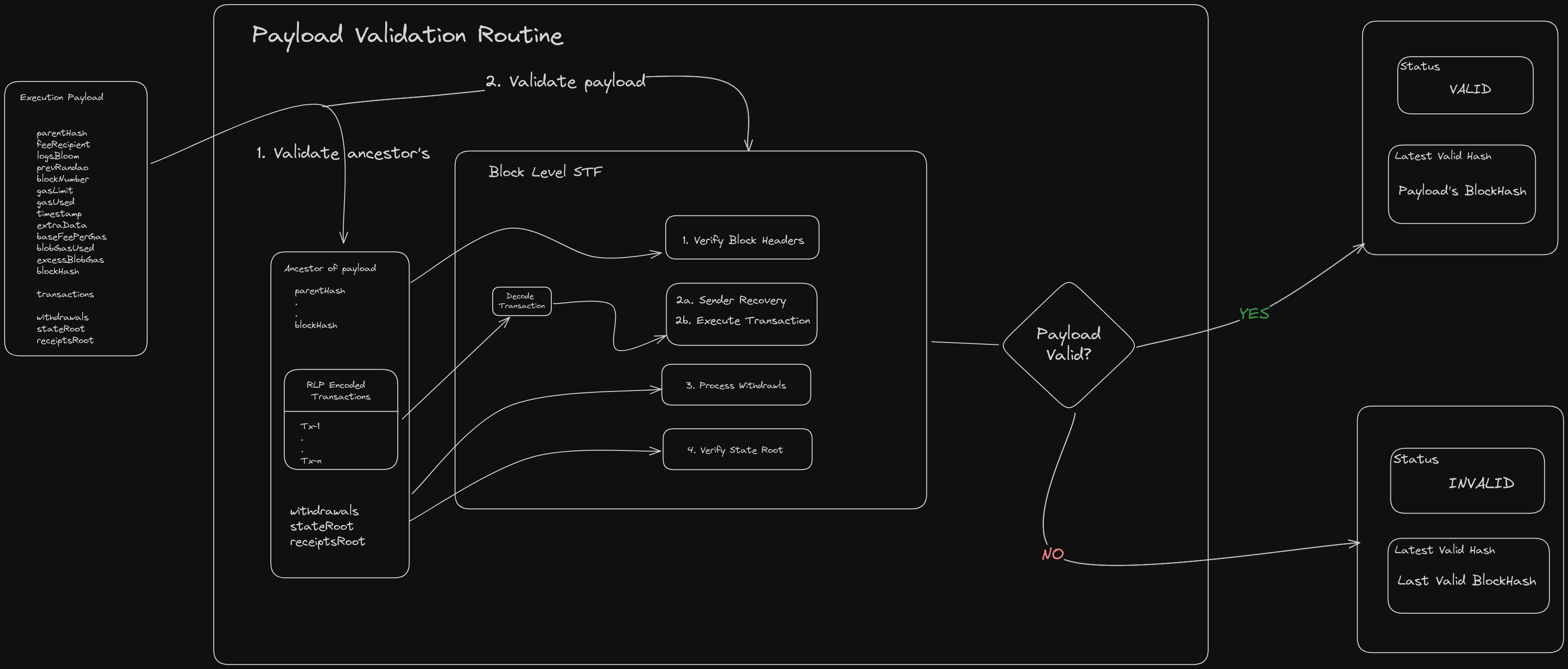
With the merge, the function of the execution layer has been altered within the Ethereum network. Previously, it was tasked with the responsibility of managing the consensus of the blockchain, ensuring the correct order of blocks, as well as handling reorganizations. However, after the merge, these tasks have been delegated to the consensus layer, resulting in a significant simplification of the execution layer. Now, we can conceptualize the execution layer as primarily carrying out the state transition function.
In order to gain a better understanding of the aforementioned concept, it is beneficial to examine the perspective of the consensus layer in relation to the execution layer. The consensus specification defines the process execution payload in the deneb beacon chain specs, which is carried out by the beacon chain while undergoing several verifications required to validate a block and advance the consensus layer. The execution layer here is represented by the execution_engine function, which serves as a means of communication between the consensus layer and the execution layer and has a lot of varied complexities to it.
During process execution payload , we begin by conducting several high-level checks, including verifying the accuracy of the parent hash and validating the timestamp. Additionally, we perform various lightweight verifications. Subsequently, we transmit the payload to the execution layer, where it undergoes block verification. The notify payload function, is the lowest level function that serves as the interface between the consensus layer and the execution engine. It contains only the function's signature, without any implementation details. Its sole purpose is to transmit the execution payload to the execution engine, which acts as the client for the execution layer. The execution engine then carries out the actual state transition function, which involves verifying the accuracy of block headers and ensuring that transactions are correctly applied to the state. The execution engine will ultimately return a boolean value indicating whether the state transition was successful or not. From the standpoint of the consensus layer, this is simply the validation of blocks.
This is a simplified description of the block level state transition function (stf) in go. The stf is a crucial component of the block validation and insertion pipeline. Although the example is specific to Geth, it represents the functioning of the stf in other clients as well. It is worth mentioning that the state transition function is rarely referred to by its name in the code of different clients, save for the EELS python spec client. This is because its real operations are divided across many components of the client's architecture.
func stf(parent types.Block, block types.Block, state state.StateDB) (state.StateDB, error) { //1
    if err := core.VerifyHeaders(parent, block); err != nil { //2
            // header error detected
            return nil, err
  }
  for _, tx := range block.Transactions() { //3
      res, err := vm.Run(block.header(), tx, state)
      if err != nil {
              // transaction invalid, block is invalid
              return nil, err
      }
      state = res
  }
  return state, nil
}- State transition function's parameters and return values
- In this context, we examine both the parent block and the current block in order to validate certain transition logic from the parent block to the current block.
- We take the state DB in as an argument, which contains all the state data related to the parent block. This represents the most recent valid state.
- We return the state DB representing the updated state after the state transition
- if the state transition fails we don't update the state DB and return the error
- In the state transition functions procedure we first verify the headers
- As an illustration of the failure of header verification, let us consider the gas limit field, which is also of historical significance. Currently, the gas limit stands at around 30 million. It's important to note that the gas limit is not fixed within the execution layer. Block producers have the capacity to modify the gas limit using a technique that allows them to increase or decrease it by 1/1024th of the gas limit of the preceding block. Therefore, if you raise the gas limit from 30 million to 40 million within a single block, the header verification will fail because it exceeds the threshold of 30 million plus one-thousandth of 30 million.
- Additional instances of header verification failure can arise when the block numbers are not in sequential order. Typically, the beacon chain is responsible for detecting such discrepancies, although there are instances where it is detected at this stage as well. Failures may also arise when the 1559 base fee is not accurately updated according to the comparison between the last gas used and the gas limit.
- Once the header verification is completed, we consider the environment in the header as the environment in which the transactions should be executed and we apply the transactions. We iterate over the transactions in the block and execute each transaction in the EVM.
- The block headers are passed to the EVM in order to provide the necessary context for processing the transaction. This context includes instructions such as coinbase, gas limit, and timestamp, which are required for proper execution.
- Additionally we pass in the transaction and the state
- In the event of a failed execution, we simply return the error, indicating an invalid transaction within the block and thereby rendering the block invalid. Within the execution layer, the presence of anything erroneous in a block renders the entire block invalid, as it contaminates the block as a whole.
- Once we confirm the validity of the transactions, we proceed to update our state with the result . The state now represent the accumulated state that has all the transaction in the new block applied to it.
From the standpoint of beacon chains, the state transition function mentioned above is encompassed by the invocation of the "new payload" function.
func newPayload(execPayload engine.ExecutionPayload) bool {
    if _, err := stf(..); err != nil {
        return false
  }
  return true
}
The beacon chain invokes the new payload function and transfers the execution payload as an argument. On the execution layer, we invoke the state transition function using the information from the execution payload. If the state transition function does not produce an error, we return true. Otherwise, we return false to indicate that the block is invalid.
Geth
Transaction Execution in Geth
Geth, like other Ethereum execution clients, processes transactions by verifying signatures, checking nonces, deducting gas fees, and updating the state. Transactions first enter the mempool, where they wait to be included in a block. Once picked up, Geth executes them, modifying account balances, contract storage, and other state data.
🔗 Transaction Execution Specs Code
Block Processing & State Updates
Every new block contains multiple transactions that Geth processes in order. Once all transactions are executed, the final state is committed, and a state root hash is stored to ensure consistency. This process follows a defined set of rules to maintain network integrity.
Networking & Peer-to-Peer Communication
Ethereum nodes communicate using DevP2P, a protocol that allows execution clients to exchange transactions and blocks. When a new transaction is sent, it propagates across the network through peer-to-peer connections, ensuring all nodes remain in sync. Each recipient verifies the transaction before forwarding it, preventing spam and invalid state transitions.
EVM Execution
At its core, Geth runs the Ethereum Virtual Machine (EVM), which processes smart contract logic. Every transaction that interacts with a contract is executed inside the EVM, ensuring consistency and determinism across all nodes.
State Sync
All execution clients require an up‑to-date world state to validate and build blocks. To bootstrap a new node's current state, clients leverage Ethereum’s DevP2P subprotocols: eth/* (wire protocol) for block headers, bodies, and receipts, and snap/1 for creating state snapshots. Using these sub-protocols, clients can choose between two sync strategies, full sync or snap sync. The difference between the snap synced node and a full block-by-block synced node is that a snap synced node started from an initial checkpoint that was more recent than the genesis block.
Let's look at how the flows of both full sync and snap sync work.
Full Sync
Full Sync trades absolute trustlessness for time and resources. The client replays every block and transaction from genesis to tip, rebuilding the state trie step by step:
- Use
GetBlockHeadersover theeth/*protocol to download every block header since genesis. - Use
GetBlockBodiesto retrieve every block’s transactions and uncles. - Sequentially execute each transaction in EVM order, updating the local trie at each block.
- Confirm that the local state trie’s root matches the tip’s root. Every state transition has been verified.
This method guarantees maximal security but can take days on mainnet and consumes significant CPU, disk, and network resources. Full sync is a naive default strategy because it starts from genesis and takes longer over time as block height continually grows. Additionally, full sync from genesis will no longer be supported after EIP-4444 is fully implemented. Syncing after EIP-4444 will be checkpoint syncs instead, meaning that syncing will start from a weak subjectivity checkpoint instead of from genesis.
Snap Sync
Snap Sync reconstructs the pivot block's state by fetching only the trie leaves (accounts and storage slots) plus Merkle proofs, then separately downloading any needed contract bytecode, and finally rebuilding the tries locally:
- Choose a recently finalized block as your pivot block.
- Over eth/*, request that block’s header via
GetBlockHeadersto learn its stateRoot. - Fetch headers up to the pivot via
eth/*, so you know which state root to target. - Download the leaves of the pivot block's world state trie and account storage trie in chunks.
- Accounts: uses
GetAccountRangeto pull contiguous world state trie leaf values. - Storage: uses
GetStorageRangesto pull consecutive storage slot leaf nodes for each account.
- Accounts: uses
- Send
GetByteCodesfor every code hash found in the account bodies to get back the contract code for that account - Locally insert every fetched leaf into a fresh snapshot DB, verifying each batch against the pivot block’s stateRoot via Merkle range proofs.
Note: In practice, clients store these fetched leaves in a snapshot-specific database format, which differs from the Merkle trie used during normal execution. This format is optimized for range queries and quick reconstruction. The full MPT structure is created and validated during the healing phase.
Healing Phase
After step 6, we have a snapshot of the pivot block’s state stored in a flat snapshot database. However, since the chain continues to progress, data can be stale, incomplete, or inconsistent. Therefore, a healing phase is required. During healing, the client walks the snapshot DB and verifies that the state data is complete and consistent with the pivot block’s stateRoot. Any missing trie nodes, storage slots, or contract bytecode are fetched using targeted snap requests. Healing ensures that the final state is complete, consistent, and can be fully reconstructed into a valid MPT.
At this point, we have a snapshot of the pivot block's state, so we apply the transactions of blocks following the pivot on the downloaded state to get to the tip of the chain.
Snap Sync reduces mainnet bootstrap times from days to hours. Its trade‑off is that it's hardware intensive for the healing phase to be able to outpace trie changes from new blocks being produced.
Both full sync and snap sync finishes when blockchain data is verified and clients catches up with the tip of the chain which enables building the latest state.
Payload building
More details in block production
Methods
New payload
Validates the payload that was built earlier by the payload building routine.

Fork choice updated
Proof-of-stake LMD-GHOST fork choice rule & payload building routine instantiation.

Internal Consensus engines
The execution layer has its own consensus engine to work with its own copy of the beacon chain. The execution layer consensus engine is known as ethone and has about half the functionality of the full fledged consensus engine of the consensus layer.
| Function | Beacon (Proof-of-stake) | Clique (Proof-of-authority) | Ethash (Proof-of-work) |
|---|---|---|---|
| Author: Eth address of the block minter | If the header is classified as a Proof of Stake (PoS) header, with a header difficulty set to 0, we will retrieve the header's coinbase. Otherwise, we will forward the header to the beacon's ethone engine (either clique or ethash) for further processing. | Obtains the account address that created the block. The process of recovering the public key from the header's extraData is performed by ecrerecover. | |
| Verify Header(s): Processes a batch of headers and validates them according to the rules of the current consensus engine. : | Split the headers based on Terminal Total difficulty into pre and post TTD batches . Verify the pre batches with the ethone engine and the post by beacon's verify header. | ||
| Here we perform block header verification similar to the one in the execution layer Specs wiki page and covered below in the client code table. | We verify the time of the header is not greater than system time. | ||
| If it is a checkpoint block (1'st slot of an epoch), then ensure it has no beneficiary. | |||
| The header nonce can take on two values: 0x00..0, which indicates a vote to add a signer, or 0xff..f, which indicates a vote to drop a signer. However, at checkpoints, we can only vote to drop a signer. | |||
| The extraData length mush account for vanity + signature. At checkpoints, the extraData contains the signer list + signature. | |||
| Header gas checks. | |||
| Retrieve the snapshot | |||
| On checkpoint blocks verify the signers in the snapshot against the extraData | |||
| Invoke the verify Seal function to determine whether all the criteria for the signature included in the header have been satisfied. The recovery process involves extracting information from the header and the list of recent signers in the Clique object. We then verify whether the signer is included in the snapshot. | |||
| Verify Uncles | If the Header is a Proof-of-stake header, check that the length of uncles is 0. If the header is not Proof-of-stake, the process of verifying uncles is done via the ethone engine. | In Clique no uncles should be present | |
| Prepare: Initializes the consensus fields of a block's header. | If TTD is reached we set the header's difficulty to beacon's difficulty of 0, else we call ethone's prepare | Create the voting snapshot by supplying the parent hash and number.During the reverse iteration process, we start from the block number and proceed backwards. We stop the iteration if we reach the genesis block, if we are using a light client that doesn't store parent blocks, if we reach an epoch by traversing backwards, or if the headers traversed exceed the soft Finality value (indicating that the segment is considered immutable). At the checkpoint where we stop the iteration, we create a snapshot. | |
| If we are at the end of an epoch, we will go through the addresses in the proposals field of the snap object and choose one randomly as the coinbase. If the proposal is authorized, we will cast an auth-vote; otherwise, we will cast a drop vote. | |||
| Set the header difficulty based on the signer's turn (2 if the signer is in turn and 1 if not) | |||
| Verify that the extraData contains all the necessary elements, including extraVanity and a list of signers if the block occurs at the end of the epoch. This is added to the Header's extraData field. | |||
| Finalize: After making changes to the state, the state database may be updated, but this action does not involve the assembly of the block. | If the header is not a Proof-of-stake header, we execute the finalize function of ethone. Otherwise, we loop through the withdrawals in the block, converting their amounts from wei to gwei. We then modify the state by adding the converted amount to the address associated with the current withdrawal. | Clique has no post-transaction consensus rules, no block rewards in proof of authority | |
| FinalizeAndAssemble: Finalizes and assemble the final block | If the header is not a Proof-of-stake header, we invoke ethone's FinalizeAndAssemble. If there are no withdrawals and the block is after the Shanghai fork, we include an empty withdrawals object. Next, we invoke the finalize function to calculate the state root. We then assign this value to the root property of the header object. Finally, we construct a new block by combining the header, transactions, uncles, receipts, and withdrawals. | Verify that there are no withdrawals, invoke the finalize function, calculate the state root of our stateDB, and assign it to the the Header . Construct a new block using the header, transactions, and receipts. | |
| Seal: Generates a sealing request for a block and pushes the request into the given channel | If the header is not a Proof-of-stake header, we invoke ethone's seal. Otherwise, we take no action and return nil. The verification of the seal is performed by the consensus layer. | Make sure that the block is not the initial block, obtain the snapshot, and confirm that we have the authority to sign and are not included in the list of recent signers. Coordinate the timing of our respective turns, apply the sign function to sign, and transmit the securely sealed block through the designated channel. | |
| SealHash: Hash of the block prior to sealing | |||
| CalcDifficulty: Difficulty adjustment algorithm, returns the difficulty of the new block |
Client code
| EELS(cancun) | Geth | Reth | Erigon | Nethermind | Besu | |
|---|---|---|---|---|---|---|
| validate_header | ||||||
| H_{gasLimit} < P(H)_\{H_\{gasLimit'}} + floor(\frac\{P(H)_\{H_\{gasLimit'}}}{1024} ) | validate_header -> calculate_base_fee_per_gas -> ensure | |||||
| H_{gasLimit} > P(H)_\{H_\{gasLimit'}} - floor(\frac\{P(H)_\{H_\{gasLimit'}}}{1024} ) | '' | |||||
| calculate_base_fee_per_gas -> check_gas_limit | ||||||
| H_{timeStamp} > P(H)_\{H_\{timeStamp'}} | validate_header-> ensure | |||||
| H_{numberOfAncestors} = P(H)_\{H_\{numberOfAncestors'}} + 1 | validate_header-> ensure | |||||
| validate_header-> ensure | ||||||
| validate_header-> ensure | ||||||
| validate_header-> ensure | ||||||
| validate_header-> ensure | ||||||
| validate_header-> [ensure](https://github.com/ethereum/execution-specs/blob/9fc7925c80ff2f3949e1cc340a4a0d36fcd4161c/src/ethereum/cancun/fork.py# | ||||||
| (this is stale , beacon chain provides this now) | ||||||
| H_{blobGasUsed} \leq MaxBlobGasPerBlock_\{=786432} | ||||||
| H_{blobGasUsed} \% GasPerBlob_\{=2^{17}} = 0 | ||||||
| ensure |
Downloader
Transaction Pools
In Ethereum two primary types of transaction pools are recognized:
-
Legacy Pools: Managed by execution client, these pools employ price-sorted heaps or priority queues to organize transactions based on their price. Specifically, transactions are arranged using two heaps: one prioritizes the effective tip for the upcoming block, and the other focuses on the gas fee cap. During periods of saturation, the larger of these two heaps is selected for the eviction of transactions, optimizing the pool's efficiency and responsiveness. urgent and floating heaps
-
Blob Pools: Unlike legacy pools, blob pools maintain a priority heap for transaction eviction but incorporate distinct mechanisms for operation. Notably, the implementation of blob pools is well-documented, with an extensive comments section available for review here. A key feature of blob pools is the use of logarithmic functions in their eviction queues.
Note that these examples are using go-ethereum, specific naming and implementation details might differ in various clients while main principles stays the same.
EVM
Wiki - EVM TODO: Move relevant code from specs into EVM
DevP2P
Data structures
More details in the page on EL data structures.
Storage and database backends
Blockchain and state data processed by execution client need to be stored in the disk. These are necessary to validate new blocks, verify history and to serve peers in the network. Client stores historical data, also called the ancient database, which include previous blocks. Another database of trie structure contains the current state and small number of recent states. In practice, clients keep various databases for different data categories. Each client can implement a different backend to handle this data, e.g. leveldb, pebble, mdbx.
Leveldb
LevelDB is one of the database implementations used by clients, providing a generic ordered key–value interface and had no knowledge of Ethereum-specific structures.
LevelDB is an embedded key–value database based on a log-structured merge tree design. Writes are first appended to a write-ahead log for crash recovery and inserted into an in-memory memtable. When the memtable is full, it is flushed to disk as an immutable sorted string table. On disk, these tables are organized into multiple levels and periodically merged through background compaction. This design favors high sequential write throughput but results in write amplification and variable latency when data is frequently updated.
Execution clients mostly switched away from this specific db implementation to more modern reimplementations with active support or more experimental designs with improved performance.
Pebble
Pebble is used by some execution clients as a replacement for LevelDB, fulfilling the same role as the primary embedded key–value store for blockchain data, execution state, and indices. Geth have chosen pebble as an alternative and now default backend because LevelDB stopped being maintained. It provides same set of features with certain advantages as its development continues.
Compared to LevelDB, Pebble retains the LSM-tree architecture but improves it for write-heavy, latency-sensitive workloads typical of Ethereum execution. It supports multiple active memtables to reduce write stalls, exposes detailed SSTable and compaction metadata, and provides significantly more control over compaction behavior. These improvements allow clients to better manage write amplification and achieve more predictable performance under frequent state updates. Pebble also offers stronger batch semantics and snapshot support, enabling execution clients to better align database operations with block execution and concurrent RPC reads.
https://github.com/cockroachdb/pebble
MDBX.
Read more about its features. Additionally, boltdb has a page on comparisons with other databases such as leveldb, here. The comparative points mentioned on bolt are applicable to mdbx.
Resources and References
- Engine Api Spec • archived
- Engine API: A Visual Guide • archived
- Engine API | Mikhail | Lecture 21
- "Snapping Snap Sync: Practical Attacks on Go Ethereum Synchronising Nodes" (ETH Zurich)
- Geth Docs – Sync Modes • archived
- YouTube – "How to Sync an Ethereum Node with Snap Sync"
- Ethereum.org – Execution Layer Sync Modes • archived